
Report 05 / 05
Casino data literacy
The Gambling Commission’s income is not the casino industry’s revenue
A worked reading of the regulator’s 2024–25 accounts separates licence fees, operating income, complaint counts and industry gambling yield.
Start by identifying whose accounts you opened
The Gambling Commission's annual report is an account of the regulator's work and finances. A monetary total in it is not automatically the revenue of gambling businesses, still less the revenue of online casinos alone. Before quoting a figure, name the organisation, the table and the unit. That small discipline prevents a large category error.
This worked reading uses the 2024–25 report, covering 1 April 2024 to 31 March 2025. It is a chosen historical example, not a claim that this is the newest annual report available. The pages were retrieved on 19 September 2026. Their original publication and update dates remain separate from this research date.
The method is a table-to-sentence audit. First transcribe the table's headings and figures. Then reproduce any calculation and write the narrowest sentence it supports. Finally test an alternative headline to see whether it introduces an unsupported population, sector or causal claim. The exercise is useful for readers checking online casino coverage, but the accounts themselves cover the Commission rather than that single part of the market.
Sources: Annual report and accounts 2024 to 2025; Annual report 2024 to 2025: performance report.
The licence-fee table reconciles exactly
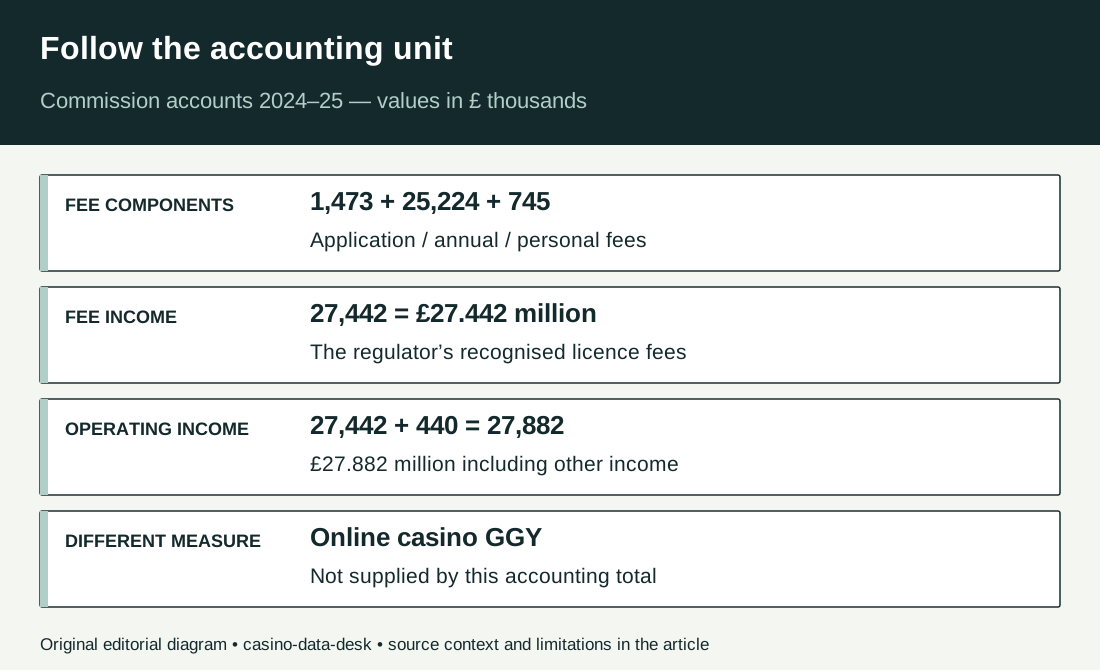
Note 4a records Gambling Act 2005 fee income recognised in the year. In the 2024–25 column, measured in thousands of pounds, operator licence application fees are 1,473, operator annual fees are 25,224 and personal licence applications are 745. The total is 27,442. These labels identify the income streams; none is labelled online casino revenue.
The arithmetic is 1,473 + 25,224 + 745 = 27,442. Because the unit is £ thousands, the total equals £27,442,000, or £27.442 million. Leaving out the unit would understate the amount by a factor of a thousand. Describing it as £27,442 million would overstate it by the same factor.
This is a reconciliation, not an independent audit of the underlying transactions. The published note says the recognised fee income is included in the statement of comprehensive net expenditure as licence-fee income. Matching the total between those two places tests whether the reader has carried the number across correctly. It does not establish how much any particular casino paid, how many players it served or what customers lost.
Sources: Gambling Act 2005 income recognised.
Operating income contains another line
The statement of comprehensive net expenditure shows licence-fee income of 27,442 and other income of 440, again in £ thousands. Adding them produces total operating income of 27,882. In pounds, that is £27.882 million. The licence-fee total and operating-income total therefore answer related but different accounting questions.
The original comparison table below preserves that distinction instead of selecting the larger number as if it were simply a newer version of the smaller one. A sentence about licence fees should use the fee line; a sentence about operating income should identify the wider total. The extra £440,000 should not be silently described as casino stakes or player deposits.
The same statement explains that grant-in-aid funding for National Lottery expenditure is treated as financing and taken to reserves rather than revenue. That is a reason to read the account notes before equating a revenue total with every resource available to an organisation. This article does not rebuild the regulator's full funding model. It follows the two published income lines far enough to prevent an unsupported casino-market interpretation.
Table 01 Source · as of 19 September 2026 · scroll across to read every column.
| Line | Published £ thousands | Converted pounds | Check |
|---|---|---|---|
| Operator application fees | 1,473 | £1,473,000 | Fee-income component |
| Operator annual fees | 25,224 | £25,224,000 | Fee-income component |
| Personal licence applications | 745 | £745,000 | Fee-income component |
| Total licence-fee income | 27,442 | £27,442,000 | 1,473 + 25,224 + 745 |
| Other income | 440 | £440,000 | Separate operating-income line |
| Total operating income | 27,882 | £27,882,000 | 27,442 + 440 |
A change calculation does not identify its cause
The fee-income table gives 25,825 for 2023–24 and 27,442 for 2024–25, both in £ thousands. The difference is 1,617, or £1.617 million. Dividing that difference by the earlier value gives 1,617 ÷ 25,825 × 100 = approximately 6.26%. Rounding to one decimal place gives a 6.3% increase in this recognised fee-income measure.
That is the complete supported calculation. It is not a 6.3% rise in online casino participation, casino profits, stakes or gambling harm. The denominator is the regulator's earlier recognised fee income. Replacing that denominator in the prose would change the claim while leaving an apparently precise percentage on the page.
Nor does the subtraction establish why the total changed. A causal explanation would need evidence about the relevant fee streams and recognition rules, not just two annual totals. A reader can report a measured accounting change while leaving its explanation unresolved. Precision in the arithmetic should make the scope clearer, not conceal the fact that the calculation says nothing about individual player experiences.
Sources: Gambling Act 2005 income recognised.
Gross gambling yield belongs to a different measurement system
The Commission's regulatory-returns guidance defines gross gambling yield through stakes and other amounts accruing in connection with licensed activities, less prizes or winnings, using its stated calculation rules. That is an operator reporting measure. Licence fees recognised by the regulator are a different subject, even when both figures appear in material published by the same organisation.
An online casino market question therefore needs the relevant industry dataset, category and period. The regulator's accounts cannot supply a missing casino-only GGY figure by relabelling its own fee income. They also cannot supply deposits or a population count through division by an assumed customer spend. The missing inputs would remain assumptions, however neat the resulting chart looked.
For a source register, put the annual accounts and regulatory-returns guidance on different rows. Name the reporting entity, measure, unit, period and exclusions on each. If an article combines the two, explain the relationship actually being asserted. This draft uses the distinction to identify a wrong substitution; it does not estimate industry size or calculate a ratio between regulator income and casino GGY.
Sources: Reporting gross gambling yield on regulatory returns.
Seven complaints against the Commission are not seven casino disputes
The annual report's complaints section says seven complaints against the Commission were reviewed under its policy during 2024–25. It then describes three at Stage One and four at Stage Two. The object of the count is the Commission's own complaint handling. It is not a total of every complaint gamblers made against gambling operators.
The check is grammatical before it is mathematical: complaints against whom? Removing that phrase from a headline changes what the number appears to measure. The same problem would arise if a chart labelled the seven cases as casino complaints, without the underlying population and process. The source does not support that label.
This is an especially useful example for a casino reader because a small count can look reassuring if its subject is lost. It cannot be used here as evidence that casino disputes are rare, that operators have improved, or that a particular business treats customers well. To investigate those claims, first identify a dataset that actually counts the relevant disputes and explains its coverage. An institutional annual report does not automatically provide it.
Sources: Annual report complaints.
Publication date and reporting period are different fields
The official GOV.UK publication record says the report covers 1 April 2024 to 31 March 2025 and gives a publication date of 29 July 2025. The Commission's HTML report page gives a later publication date of 15 October 2025. These are dates attached to different publication records for the same reporting period, not competing dates for the underlying financial year.
The GOV.UK page also records a January 2026 update adding the Trust Statement. A page update does not, by itself, turn the annual-account figures into 2026 trading results. Preserve what changed, where the page states it. This article does not infer that a later page date means every number was revised.
For your notes, use three fields: covered period, source publication or update date, and retrieval date. Add a fourth for any correction described by the source. That layout prevents a freshness label from swallowing the reference period. It also makes it possible to locate the version used if a later researcher sees a different web timestamp. None of these dates should be silently rewritten to make an older reporting period look current.
Sources: Annual report and accounts 2024 to 2025; Gambling Commission annual report and accounts 2024 to 2025.
Write a sentence that survives the loss of its table
A defensible sentence from this exercise is that the Commission recognised £27.442 million in Gambling Act 2005 fee income in 2024–25, according to note 4a, with the underlying table expressed in thousands of pounds. That sentence keeps the entity, measure and period attached. It does not require the reader to infer them from a chart title several paragraphs away.
By contrast, a sentence saying that UK casinos earned £27.442 million would swap the regulator for the regulated industry and change the measure. The number would be copied correctly while the assertion became wrong. This is why fact checking a statistic involves more than checking its digits.
Carry the same discipline into a spreadsheet: preserve the raw value, the raw unit, any converted value, the formula and the source URL. Leave a missing sector breakdown blank. If the question is online casino revenue and the table is regulator fee income, choose another dataset rather than manufacture a casino share. The original arithmetic here is reproducible; the sector attribution it cannot support remains expressly unmade.
Questions answered
Why do two official figures for the same thing disagree?
First check whether they are actually the same measure. Here licence-fee income and total operating income differ because the latter includes other income.
What does gross gambling yield measure?
The Commission’s returns guidance uses stakes and other relevant accruing amounts less prizes or winnings, under its specified rules. It is distinct from the regulator’s own fee income.
Does the UK have a gambling problem?
The regulator’s annual accounts cannot answer that prevalence question. It needs population research with definitions and methods attached, rather than a fee or complaint total.
Are the annual report’s complaints figures all complaints against casinos?
No. The seven discussed here are complaints against the Commission under its own policy. Preserve that subject when citing the figure.
Does a 2026 page update make these 2026 financial results?
No. This worked example still covers 1 April 2024 to 31 March 2025. A later publication update or retrieval date does not change the reporting period.