Facts checked Article
Casino data literacy
Why two official online gambling GGY tables do not reconcile
The Commission’s market overview and industry statistics count different things. Keep their coverage, periods and bonus treatment attached to the numbers before doing arithmetic.
The mismatch begins with the dataset, not the subtraction
Two official figures can use the label gross gambling yield and still be unsuitable for direct comparison. The Gambling Commission’s market overview to March 2026 reports £1.55 billion in total online GGY for January to March 2026. Its annual industry-statistics announcement for April 2025 to March 2026 reports £8.3 billion for Remote Casino, Betting and Bingo, or RCBB.
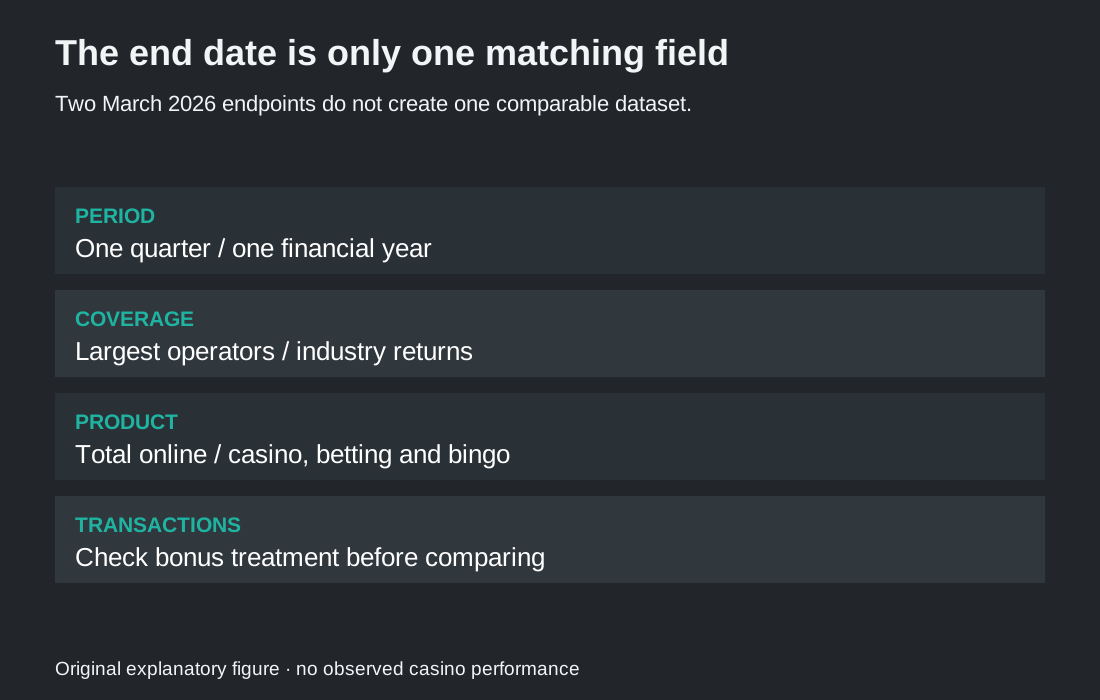
Those are not two measurements of an identical quarter. They differ in reporting period and collection scope. The market overview expressly warns against comparison with the industry-statistics dataset because it does not cover all operators and may include free bets and bonuses.
That warning is the starting point for analysis, not a footnote to discard after calculating a ratio.
This article compares the published documentation retrieved on 19 September 2026. It does not rebuild the underlying returns or audit operator submissions. The task is to decide which calculations the evidence permits before producing a precise-looking figure.
Sources: Market overview - operator data to March 2026 (published May 2026); Commission releases gambling industry statistics for 2025 to 2026.
The two figures — which publication, which period, which measure
- The quarter figure
- The Gambling Commission’s market overview to March 2026 reports £1.55 billion in total online GGY for January to March 2026.Market overview - operator data to March 2026 (published May 2026) · as checked on
- The annual figure
- The annual industry-statistics announcement for April 2025 to March 2026 reports £8.3 billion for Remote Casino, Betting and Bingo, or RCBB.Commission releases gambling industry statistics for 2025 to 2026 · as checked on
- The overview’s own warning
- The market overview expressly warns against comparison with the industry-statistics dataset because it does not cover all operators and may include free bets and bonuses.Market overview - operator data to March 2026 (published May 2026) · as checked on
- What this article did
- It compares the published documentation retrieved on 19 September 2026. It does not rebuild the underlying returns or audit operator submissions.Commission releases gambling industry statistics for 2025 to 2026 · as checked on
Denominator first: each figure carries its publisher, period and measure. The two are not two measurements of an identical quarter.
Put the two records side by side
The market overview describes data from the largest online operators and uses January to March 2026 for the quoted online total. The annual announcement describes the customer-facing industry in Great Britain and the financial year from April 2025 to March 2026. Its RCBB line includes casino, betting and bingo, so it should not be renamed online casino revenue.
The original comparison table preserves those labels. The £1.55 billion observation and £8.3 billion observation belong in separate rows with separate scope notes. Both ending in March 2026 does not make their observation windows identical.
For an online casino article, check the product row before taking any total. An all-online or RCBB figure cannot be substituted for a casino-only measure, just as a slots figure would not automatically represent every casino product. Keep the source’s product language in the sentence.
A shorter headline is not an excuse to erase the unit being measured.
| Publication | Period attached to figure | Figure and measure | Comparison boundary |
|---|---|---|---|
| Market overview to March 2026 | January–March 2026 | £1.55bn total online GGY | Largest operators; not all operators; may include free bets and bonuses |
| Industry statistics announcement | April 2025–March 2026 | £8.3bn RCBB GGY | Annual customer-facing industry measure; casino, betting and bingo combined |
| A valid casino-only comparison | Matching documented periods | No total reconstructed here | Requires matching product, coverage and measurement rules |
Sources: Market overview - operator data to March 2026 (published May 2026); Commission releases gambling industry statistics for 2025 to 2026; How we prepare our industry statistics.
Multiplying by four does not repair the scope
It is possible to calculate £1.55 billion × 4 = £6.20 billion. It is not justified to call that calculation the annual RCBB figure. It simply repeats one quarter’s amount four times.
The operation neither supplies the other three quarters nor changes which operators and transactions the source includes.
Subtracting that synthetic £6.20 billion from £8.3 billion produces £2.10 billion. The arithmetic is correct, but the difference is not an estimate of missing operators, an unlicensed market or hidden gambling activity. Several definitions have changed between the inputs, so the residual cannot be assigned to one imagined cause.
Label the calculation as a rejected comparison if it is shown at all. A chart with a segment called “unreported” would assert knowledge the sources do not provide. Precision in the subtraction cannot compensate for incompatible inputs.
The useful result of this exercise is the decision not to interpret the difference as a measured category.
Sources: Market overview - operator data to March 2026 (published May 2026); Commission releases gambling industry statistics for 2025 to 2026.
GGY is a defined return, not deposits or net profit
The Commission’s regulatory-return guidance sets out GGY as A + B − C: relevant stakes, other directly connected accruals within the definition, less prizes or winnings. This is a defined measure of gambling activity, not a general label for every payment entering a business.
For an invented, simplified record with £1,000 in qualifying stakes, no additional B amount and £940 in qualifying prizes, the calculation is £1,000 + £0 − £940 = £60. The example assumes all the entries belong in those categories. It does not model a full casino return, deposits, bonus accounting or operating profit.
Costs such as staffing and other business expenses are not established by that three-number illustration. A £60 result therefore cannot be relabelled £60 net profit. Nor can a total deposit figure be inserted as stakes without transaction evidence.
Returned funds can be staked again, and a balance movement is not automatically a new gambling transaction. Preserve the measure’s definition before comparing its scale.
Sources: Regulatory returns guidance - Reporting gross gambling yield (GGY), value of gross annual sales and annual proceeds on regulatory returns; How we prepare our industry statistics - Definitions of terms.
Gross gambling yield — A + B − C on an invented record
The example assumes all the entries belong in those categories. It does not model a full casino return, deposits, bonus accounting or operating profit.
Take A: relevant stakes
The invented, simplified record has £1,000 in qualifying stakes.
Add B: other directly connected accruals
The example has no additional B amount, so B is £0.
Subtract C: prizes or winnings
Qualifying prizes are £940. The calculation is £1,000 + £0 − £940 = £60.
What the result means
£60 is GGY for that simplified record. It cannot be relabelled £60 net profit: costs such as staffing are not established, and a total deposit figure cannot be inserted as stakes without transaction evidence.
Bonus treatment belongs in the method column
The regulatory-return guidance distinguishes free bets and bonuses according to whether the customer has an unrestricted right to receive a cash equivalent. It explains how qualifying stakes and prizes enter the calculation. The market overview, separately, warns that its dataset may include free bets and bonuses.
The point is not that every promotional transaction increases GGY or that one series is wrong. It is that transaction treatment can differ between collections. A reader cannot remove that difference by subtracting an invented bonus allowance or applying a percentage found on an unrelated operator page.
For a proposed reconciliation, request the actual definitions used by both datasets and the relevant matching data. If a required adjustment is not published, record it as unavailable. The correct output can be a table showing why the comparison is not identified.
This article does not quantify the effect of bonus treatment on either published total or claim that it explains the entire gap.
Sources: Regulatory returns guidance - Reporting gross gambling yield (GGY), value of gross annual sales and annual proceeds on regulatory returns; Market overview - operator data to March 2026 (published May 2026).
An account denominator would create another comparison
The Commission’s definitions describe active accounts in terms of accounts used for gambling in the reporting period. An account count is not automatically a count of distinct people. The market overview’s notes also explain that activity across product categories and months can create repeated counting in account measures.
Before dividing GGY by accounts, check whether the numerator and denominator cover the same operators, products and period, and whether the account figure is a total, an average or a count of distinct accounts. Even a correctly aligned calculation would need an honest label such as yield per counted account under that definition.
It would not automatically describe the typical customer’s loss.
We have not calculated such a ratio here. Attaching an account denominator to the two unmatched totals would add a further source of ambiguity. For an article about online casinos, the requirement is especially concrete: the account measure must concern the casino activity you are describing, rather than all products combined.
Sources: How we prepare our industry statistics - Definitions of terms; Market overview - operator data to March 2026 (published May 2026).
Before dividing GGY by accounts — the alignment checks
An account count is not automatically a count of distinct people; activity across product categories and months can create repeated counting in account measures.
Ticks are kept only in this browser and are never sent anywhere.
Show what a valid arithmetic comparison would require
Imagine a synthetic dataset with two quarters, each covering the same named operator group, the same online casino products and the same transaction rules. Suppose its GGY is £100 million in the first quarter and £110 million in the second. The recorded difference is £10 million, and the relative increase is (£110 million − £100 million) ÷ £100 million × 100 = 10%.
The values are invented. Their purpose is to make the assumptions visible. Even with those assumptions satisfied, the calculation would describe the defined dataset, not automatically the whole market.
It would not identify why the change occurred or how it was distributed across players.
Before using real values, also check whether either period has been revised and whether both were taken from the same release version. Archive the data filename or page and its retrieval date. That protects a later reader from combining an older first-period estimate with a revised second-period number and mistaking the inconsistency for a market event.
Sources: How we prepare our industry statistics.
A valid arithmetic comparison — what the synthetic dataset assumes
With those assumptions satisfied, £100 million to £110 million is a £10 million difference and a relative increase of 10%. The calculation describes the defined dataset, not automatically the whole market.
Ticks are kept only in this browser and are never sent anywhere.
Carry the limitations into the sentence you publish
A supported sentence identifies the Commission’s market overview, its January–March 2026 window and its total online GGY measure, then retains the limited-operator coverage. A sentence using the annual RCBB figure needs its financial year and its combined product scope. These are two different statements, not interchangeable versions of one fact.
There is also a publication-series boundary. The March 2026 market overview says it is the final publication of that dataset. Preserve that note when building a chronology; do not assume a later industry-statistics release is the next observation in the same series.
A new presentation needs its own comparability check.
The public page’s brief introductory line mentions December 2025, while its title and detailed body specify the March 2026 release and January–March comparison. This article follows the explicit detailed period and records that inconsistency rather than silently altering it. No source date has been rewritten.
Industry totals do not establish the safety of gambling or predict any individual’s experience.
Sources: Market overview - operator data to March 2026 (published May 2026); Commission releases gambling industry statistics for 2025 to 2026.
Source register — terms used on this page
- Gross gambling yield (GGY)
- The Commission’s defined measure for regulatory returns: relevant stakes plus other directly connected accruals, less prizes or winnings.
- RCBB
- Remote Casino, Betting and Bingo combined; the annual industry-statistics line, not a casino-only figure.
- Market overview
- The Commission’s operator-data publication drawn from the largest online operators; the March 2026 edition says it is the final one of that dataset.
- Industry statistics
- The Commission’s annual measure of the customer-facing industry in Great Britain, prepared under its own published method.
- Active accounts
- Accounts used for gambling in the reporting period, as the Commission’s definitions describe them; not a count of distinct people.
- Free bets and bonuses
- Promotional transactions whose treatment in a return depends on whether the customer has an unrestricted right to a cash equivalent.
Questions answered
Why do two official figures for the same thing disagree?
First check whether they really measure the same thing. The market overview and industry statistics differ in coverage and may differ in bonus treatment; their quoted figures here also cover different periods.
What does gross gambling yield measure?
The Commission defines GGY for regulatory returns using relevant stakes plus other directly connected accruals, less prizes or winnings. It is not simply deposits, total stakes or net business profit.
Can I multiply quarterly online GGY by four?
You can perform the arithmetic, but it is not an observed annual total. Repeating one quarter does not supply the remaining quarters or resolve different operator and transaction coverage.
Is RCBB the same as online casino?
No. RCBB combines remote casino, betting and bingo. A casino-only statement needs a casino-specific measure with matching scope.
Can GGY divided by active accounts tell me the average player’s loss?
Not automatically. Check product, operator and period alignment and the account-count definition. Accounts are not necessarily distinct people, and a mean would not describe the distribution or a typical individual.
Which period does each figure cover?
The market overview’s £1.55 billion covers January to March 2026 for total online GGY; the annual announcement’s £8.3 billion covers April 2025 to March 2026 for RCBB. Both ending in March 2026 does not make their observation windows identical.
Is the March 2026 market overview the start of a series?
No. The March 2026 market overview says it is the final publication of that dataset, so a later industry-statistics release should not be assumed to be the next observation in the same series.
Data sources
- Market overview - operator data to March 2026 (published May 2026)
- Commission releases gambling industry statistics for 2025 to 2026
- How we prepare our industry statistics
- Regulatory returns guidance - Reporting gross gambling yield (GGY), value of gross annual sales and annual proceeds on regulatory returns
- How we prepare our industry statistics - Definitions of terms
Continue reading
The denominator changes the story
A percentage needs a denominator.
Read The denominator changes the story
How do I interpret UK gambling statistics reports when a new survey sets a new baseline?
To interpret a UK gambling statistics report, find the survey series and year first. The Gambling Survey for Great Britain began a new baseline in 2023, so its figures compare only with earlier GSGB years.
Read How do I interpret UK gambling statistics reports when a new survey sets a new baseline?
The Gambling Commission’s income is not the casino industry’s revenue
A worked reading of the regulator’s 2024–25 accounts separates licence fees, operating income, complaint counts and industry gambling yield.
Read The Gambling Commission’s income is not the casino industry’s revenue
Britain has more than one official problem gambling rate
The Gambling Survey for Great Britain puts problem gambling at 2.4%. The Health Survey for England put it at 0.3%. Both are real, both are cited — here is the source register that explains the gap.
Read Britain has more than one official problem gambling rate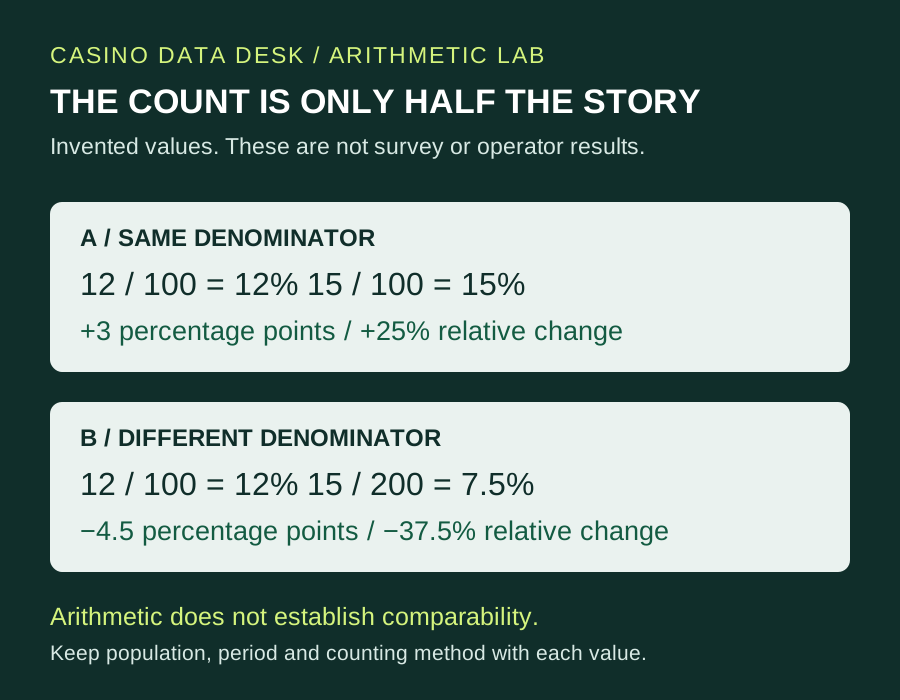
How do you read online casino statistics without misleading yourself?
A practical guide to casino revenue, active accounts and survey estimates, with a dated official-data example and an original percentage comparison tool.
Read How do you read online casino statistics without misleading yourself?
Continue reading
The Gambling Commission’s income is not the casino industry’s revenue
A worked reading of the regulator’s 2024–25 accounts separates licence fees, operating income, complaint counts and industry gambling yield.
Read The Gambling Commission’s income is not the casino industry’s revenueThe denominator changes the story
A percentage needs a denominator.
Read The denominator changes the storyHow do I interpret UK gambling statistics reports when a new survey sets a new baseline?
To interpret a UK gambling statistics report, find the survey series and year first. The Gambling Survey for Great Britain began a new baseline in 2023, so its figures compare only with earlier GSGB years.
Read How do I interpret UK gambling statistics reports when a new survey sets a new baseline?Percentage change, with context
The denominator changes the story
How do I interpret UK gambling statistics reports when a new survey sets a new baseline?
Britain has more than one official problem gambling rate
How do you read online casino statistics without misleading yourself?
The Gambling Commission’s income is not the casino industry’s revenue